
Landing at Kuala Lumpur International Airport T1 or T2 and needing to get into Kuala Lumpur? You have a number of options. Taxi/Ride share are door to door, and the most expensive if you’re a single traveller, though more cost effective for two or more. The ERL ( Express Rail Link ) runs the KLIA Ekspres and KLIA Transit services from both terminals to KL Sentral Station. It’s certainly the fastest, around half an hour, depending on which station you get on and which service. KLIAEkspres from T1 takes 28 mins. Bus is the cheapest, but you are still subject to traffic jams and it’s certainly not fastest. We decided to try out an Airport to KL city trip which gave us a lot more options depending on our destination and the number of connecting lines now available. We used three services, KLIATransit, MRT Putrajaya/Kwasa Damansara line and LRT Putra Heights/Gombak line. We have previously reviewed the KL Sentral/Putrajaya KL Transit, return by MRT with different stops to those described here.
Airport to KL city – your train options
If you have something to do in Putrajaya, even if it’s just to have a bite to eat, you can catch the KLIA Transit to Putrajaya/Cyberjaya for RM9.40 (full adult fare), then catch the next service into KL Sentral half an hour later (RM14) and your total fare of RM23.40 is a little more than half the KLIA/KL Sentral non-stop journey on either train. (RM55).
However, that’s not very convenient if you’re in a hurry, have luggage, or need to travel somewhere else on the eastern side of the Klang Valley. Depending on your destination and the nearest MRT/LRT station, there may be a combination of routes that will suit your requirements. RapidKL operates all the mass rapid and light rail transport in Klang Valley, as well as the bus services. You can use their Journey Planner to find the best routes and fares for your journey. The route map also shows connection point and whether these are a seamless connection or a tap off tap on change. It also shows stations where you can connect with the wider rail network run by Malayan Railways KTMB.
We used reloadable Touch ‘n Go cards for our journey, they will get you the cashless rate, rather than the full ticket fare and you’ll save about 10%. We are using nfc enabled cards that can be easily reloaded from our Touch ‘n Go e-wallet, but if you purchase and register a standard non-nfc card, you can reload it at kiosks in the stations, and convenience stores. Registration means you should be able to check your balance and spending online, by the next day.
KLIA T1 Level 5 – ERL Station Level 1
We needed to get to Kuala Lumpur from the International Airport down in Sepang, Selangor. The nearest station to our actual destination was Damai, on the Light Rail network LRT, Gombak line. The only way to connect to the network is by using the KLIA Transit, which stops at Putrajaya Station and has a connection with the Mass Rapid Transport System MRT. Using the MyRapid Journey planner, we pulled up our choices and decided that the fastest way would be KLIA to Putrajaya by KL Transit, then a mix of two services to reach our destination.
There are two pairs of lifts at each end of KLIA Terminal 1 that move between all levels, except 4. Escalators beside the lifts service all 5 levels. If you use the lifts, it’s important to select the correct lift (Zon B) as although all lifts stop at levels 3 and 2, from L2 down to L1, those on the Zon A side only open out to the bus and taxi bays and Zon B lifts go to the train platform. If you use the escalators, make sure you choose the correct escalator down from L2 to L1.
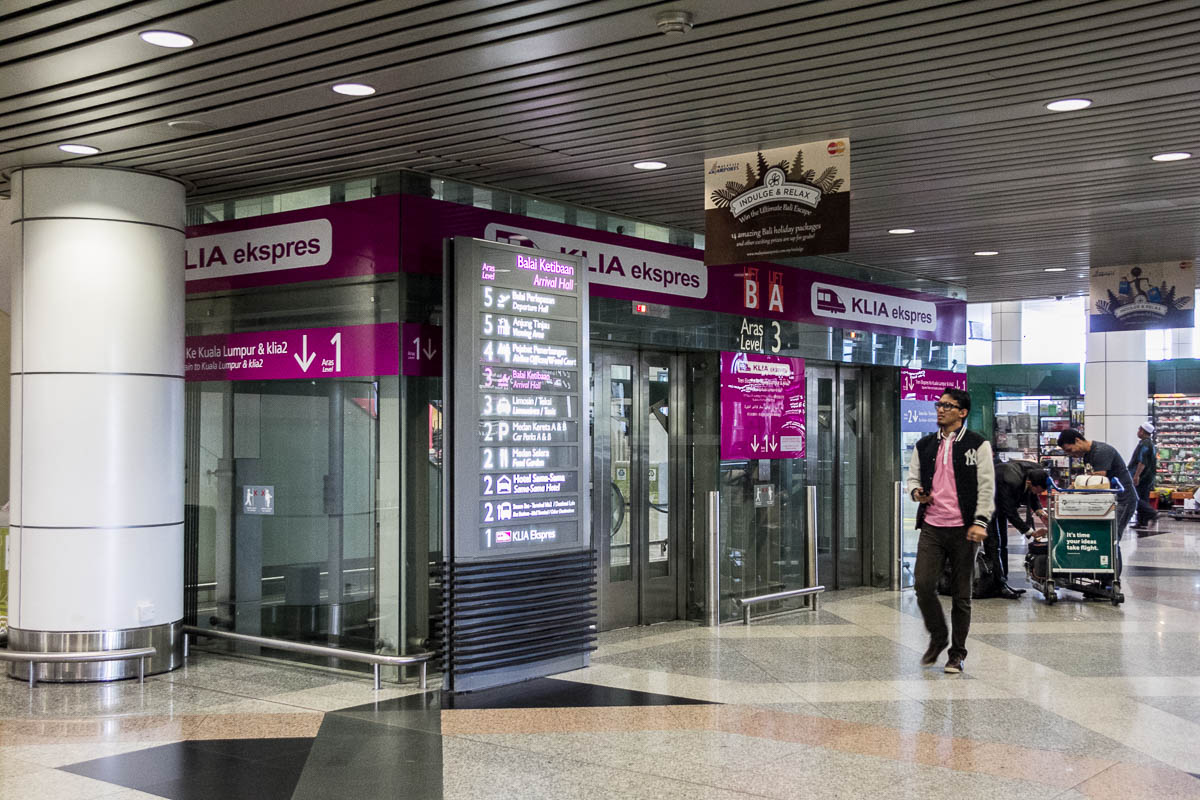
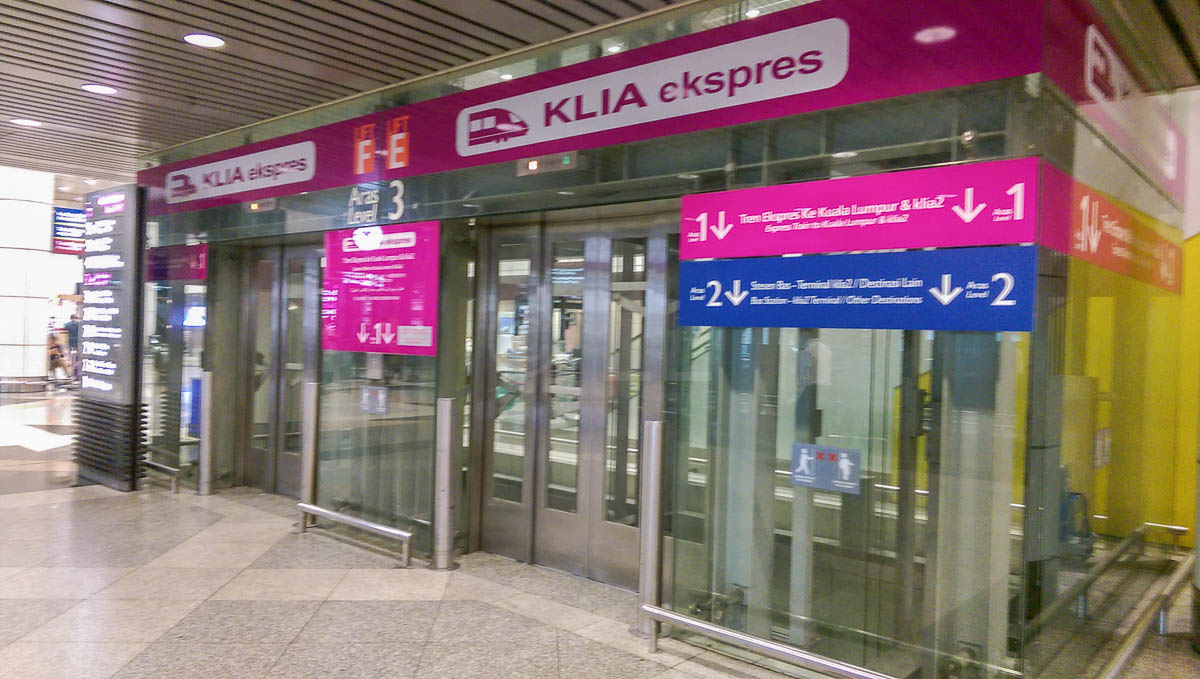
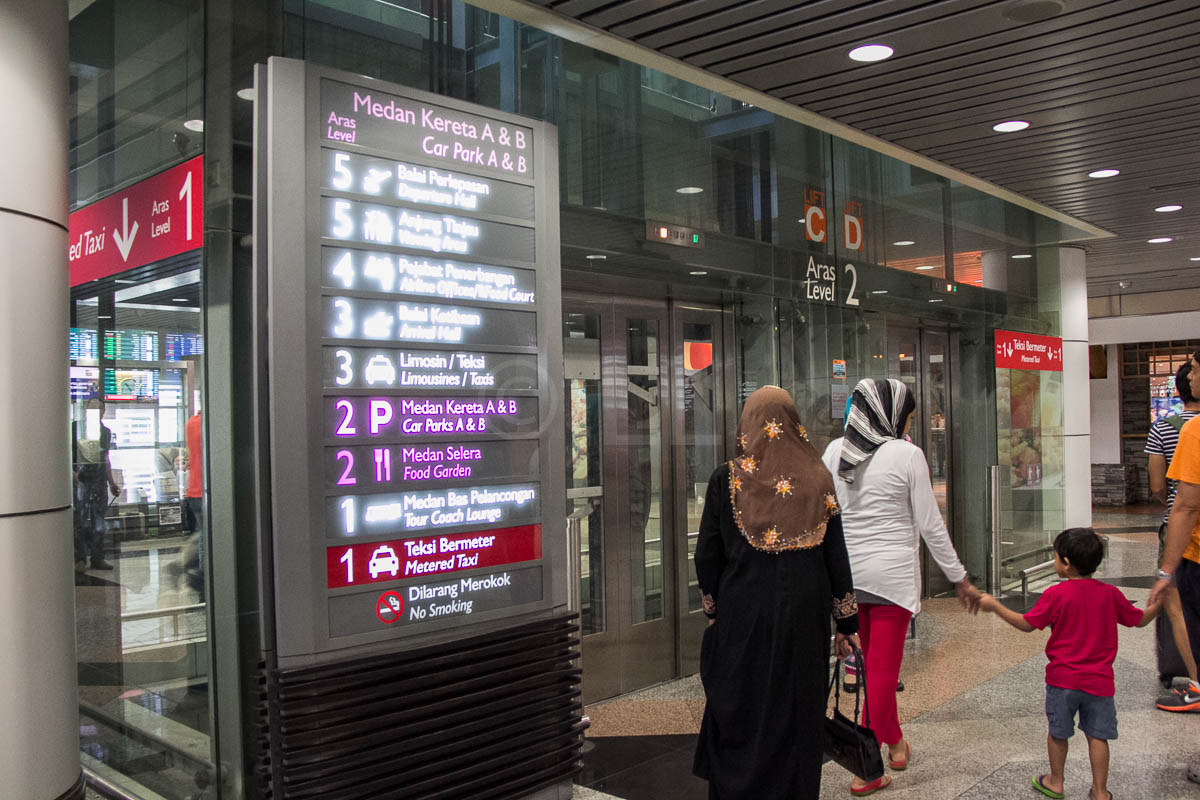
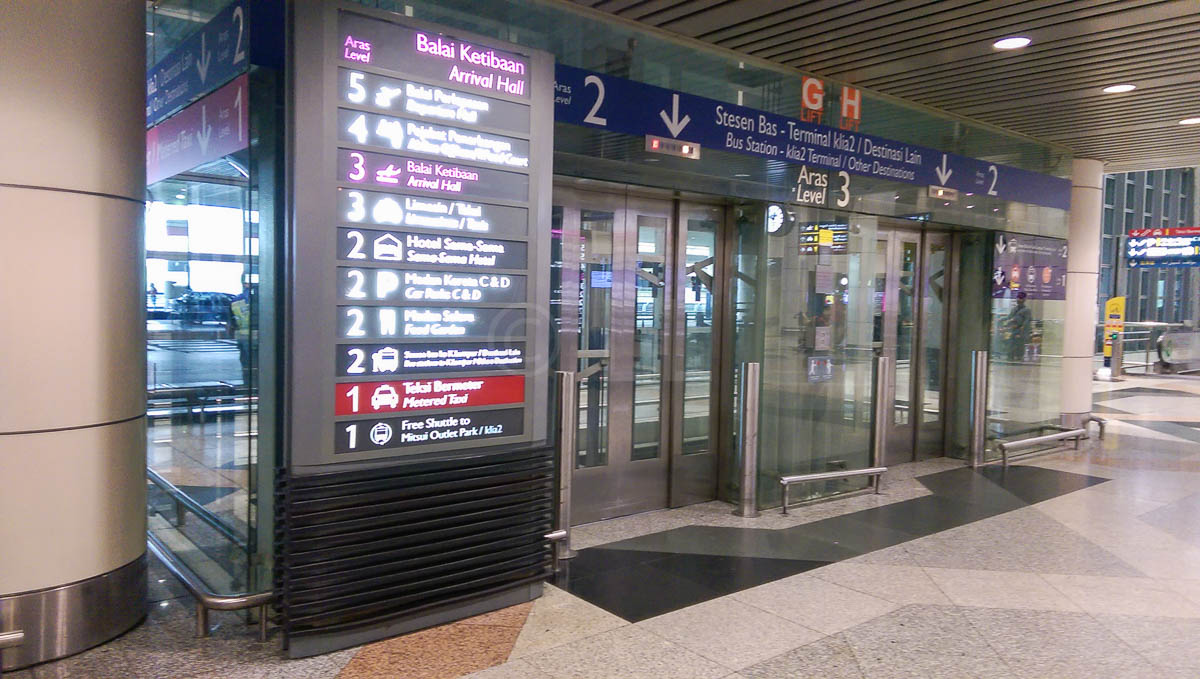
ERL (KLIA Transit) to Putrajaya Station
Express Rail Link (ERL) is the operator of the KLIA Ekspres and KLIA Transit services. KLIA Ekpres is a direct fast train connecting Malaysia’s main airport to Kuala Lumpur at KL Sentral, the main railway station. From there you can connect to a number of other rail services, as well as bus and taxi/ride share service providers. While KLIA Ekspres only stops at Terminal 1 and 2, the KLIA Transit also stops at 3 additional stations, which are also transport hubs and/or offer park and ride facilities.
You can save by purchasing tickets online, or at one of the self-service kiosks at the airport or stations, but we used our Touch ‘n Go cards for convenience, though we paid full adult fare. Use the online KLIA Transit fare schedule to get pricing and buy tickets. The tickets are valid for a month from your planned travel date.
We chose to use the KLIA Transit as we planned to travel to the second stop, Putrajaya/Cyberjaya, before connecting to the Mass Rapid Transport system MRT, for the second leg of our journey. Make sure you choose the correct train and the direction of travel. The doors of KLIA Transit are Green and the KLIA express train has Purple doors.
The KLIA Transit trains have space for standing commuters as they are used by many visiting or working at the country’s administrative Capital, Putrajaya or Cyberjaya. Bandar Tasik Selatan is also a popular stop as the transport hub connects to many rail and bus services. The trains provide priority seating for elderly and other needy passengers and space for wheelchairs.
The few minutes after leaving KLIA are a bonus for travelling plane spotters sitting on the right hand side, as the rail line runs beside one of the runways. Philippine Airlines PAL526 was taking off to Manila the day we went by. The journey to Putrajaya takes just under 15 mins, with one stop at Salak Tinggi. The train is very quiet and smooth an reached speeds up to 140kph. Trains run every 20 minutes.
Putrajaya ERL – Putrajaya MRT
The Station is part of the Putrajaya Transit Centre and to reach the MRT turn left to the MRT Station after you exit the turnstiles. There’s a Food Court on the right hand side. If you decide to eat before travelling on, and decide to catch the next Transit service, instead of the slower MRT, the fare from Putrajaya to KL Sentral is RM14 (online fare is RM12.60). Added to the RM9.40 (RM8.50 online),KLIA/Putrajaya/Cyberjaya, you’ll pay less than half the direct KLIA-KL Sentral fare (RM55 (online RM49.50).
The MRT Station is just to your left down the steps/ramp all of which is covered. Local area buses stop at the Bus Stop outside the MRT, turn left and walk past the Mondo store. Use the lifts at this entrance, or the stairs and escalators, towards the outside. Ticket machines and a self service coffee kiosk are located on the leftat the top of the stairs/escalators, opposite the turnstiles.
Putrajaya to Ampang Park by MRT
The MRT is operated by MyRapid (RapidKL) and we’d already checked their journey planner to find the quickest, most direct route and cost to our destination Damai, on the Gombak LRT line, even though there’s a bit of a walk at the interchange.
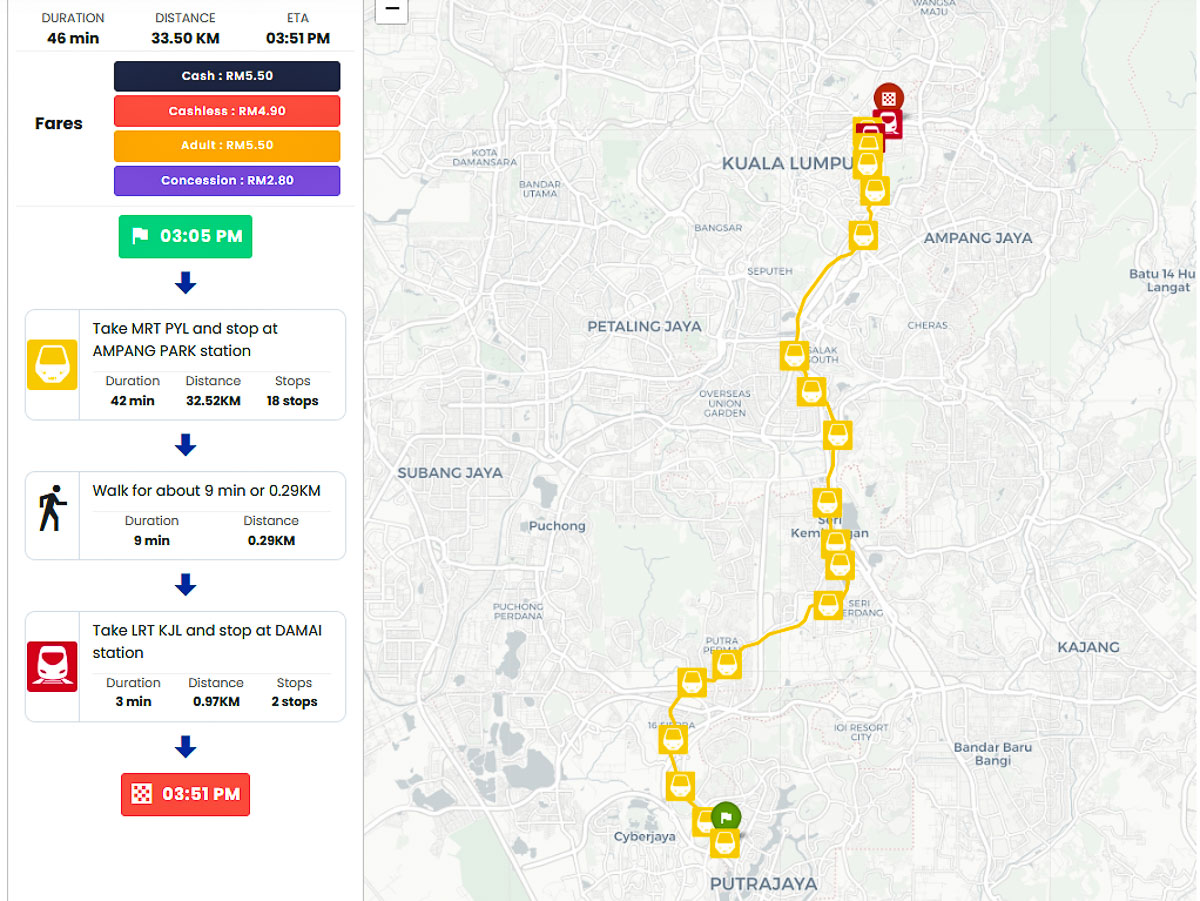
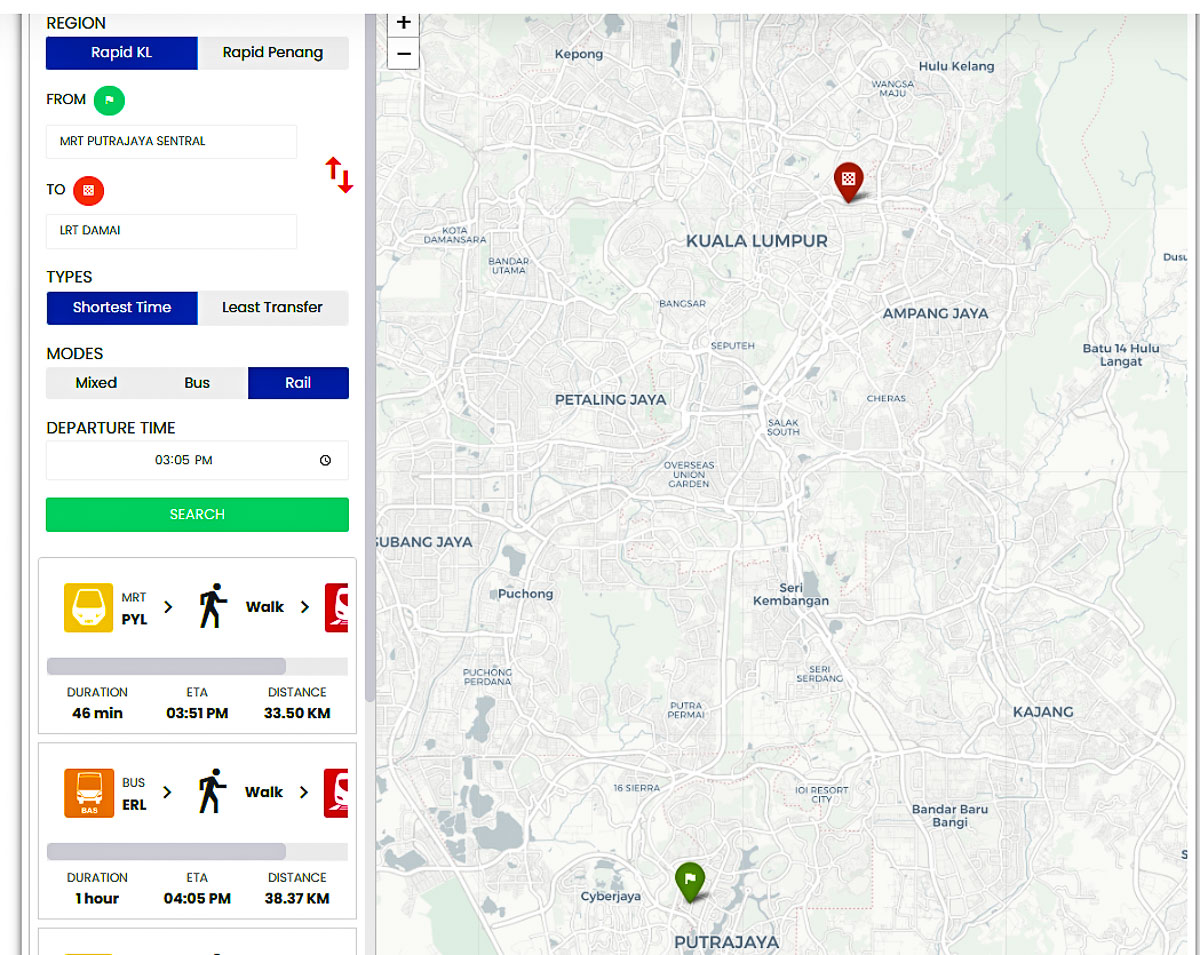
Other helpful links to help with My Rapid fares , MyRapid Route Map to download and here’s a handy A4 sized one you can print.
All the MRT stations we’ve used, have stairs and lifts, as well as both up and down escalators between the entrance level and the platform. Not all the LRT offer ‘down’ escalators. All MRT stations have protective screens and certain carriages have ‘ladies only’ sections, priority seating and wheelchair attachments close to the doors.
Flashing station names are displayed over the opening door for each stop, and carriages display the route maps mentioned above. These maps include ERL and KTMB commuter services. Interchanges are also clearly marked and coded to show which are seamless and which are completely separate, where you need to need to tap off and on again at the other station. These connections are shown as grey lines and our change at Ampang Park is one such example. We do have another guide and video detailing this route, where the destination is the MRT/LRT station at Pasar Seni with a seamless change at TRX (Tun Razak Exchange).
Ampang Park MRT to LRT
Our walk at the interchange took about 10 minutes, using a covered walkway. Signage is clear and if you need to cross the road (Jln Ampang, you can do this through the station without having to use a ticket. There are food and drink stalls on the way.
LRT Ampang Park to Damai
There are ticket machines near the turnstiles and machines to upload money onto Touch ‘n Go cards. All stations have toilets, usually before you go down/up to the platform, after the turnstiles. Maintenance is variable, though they are generally clean and have running water, but don’t count on toilet paper being available. The KL City Centre (KLCC) is not on the MRT line, so this is the interchange you need to use to KLCC and the city, wait for the train going in the direction of Putra Heights.
Our destination, Damai, is the first stop on the Gombak line in the opposite direction from Putra Heights. There are platform doors in all underground LRT Stations, but those above ground like Damai do not have these installed, although there have been suggestions that this can be a future improvement. Likewise, many of the LRT stations, particularly less crowded ones, have stairs and lifts, but may not have both up and down escalators They only have up escalators at this station.
All Malaysian rail services provide priority seating for elderly and infirm passengers. They either have labelling on the seats, on the windows above, or are coloured differently to make them obvious. If you are offered a seat, please accept, so as not to embarrass the person offering.
There is a Grab pick-up point just outside the main entrance just in front of the lift if you need it. Most Stations have these locations clearly labelled.
Getting a discount and other important add-ons.
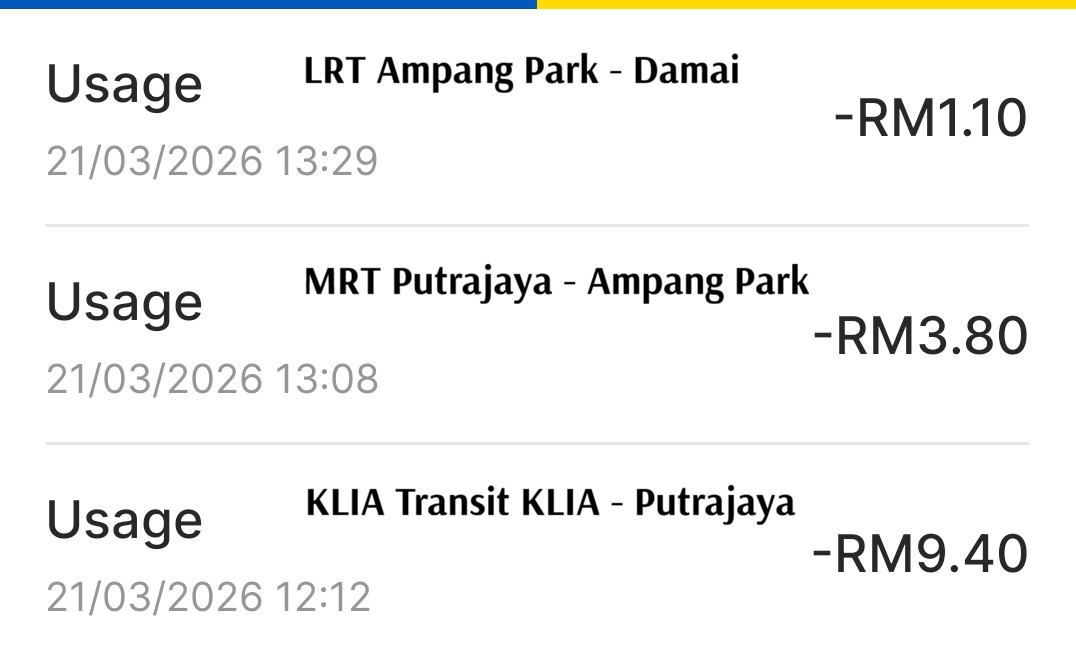
Buying your ERL tickets online gets you a discount, and going cashless (paying by card) for the MRT/LRT saves about 10%. All in, our trip took us about 2 hours including waiting and walking and cost RM14.30 each, much less than the alternatives, although it does take longer than a direct but, train, or sometimes car.



This Post Has 0 Comments